
Living species
Central Fijian banded iguana
Brachylophus bulabula
Endangered CITES I
Bula bula is Fijian for healthy or flourishing — an optimistic name for a lizard whose forests are not. This is the banded iguana of Fiji’s central and northwestern islands, including Viti Levu, Ovalau and Kadavu.
For two centuries almost every green banded iguana from Fiji was filed under B. fasciatus. In 2008 a team led by J. Scott Keogh showed that central-island animals form their own lineage, closer in some analyses to the crested iguana than to true Lau fasciatus.
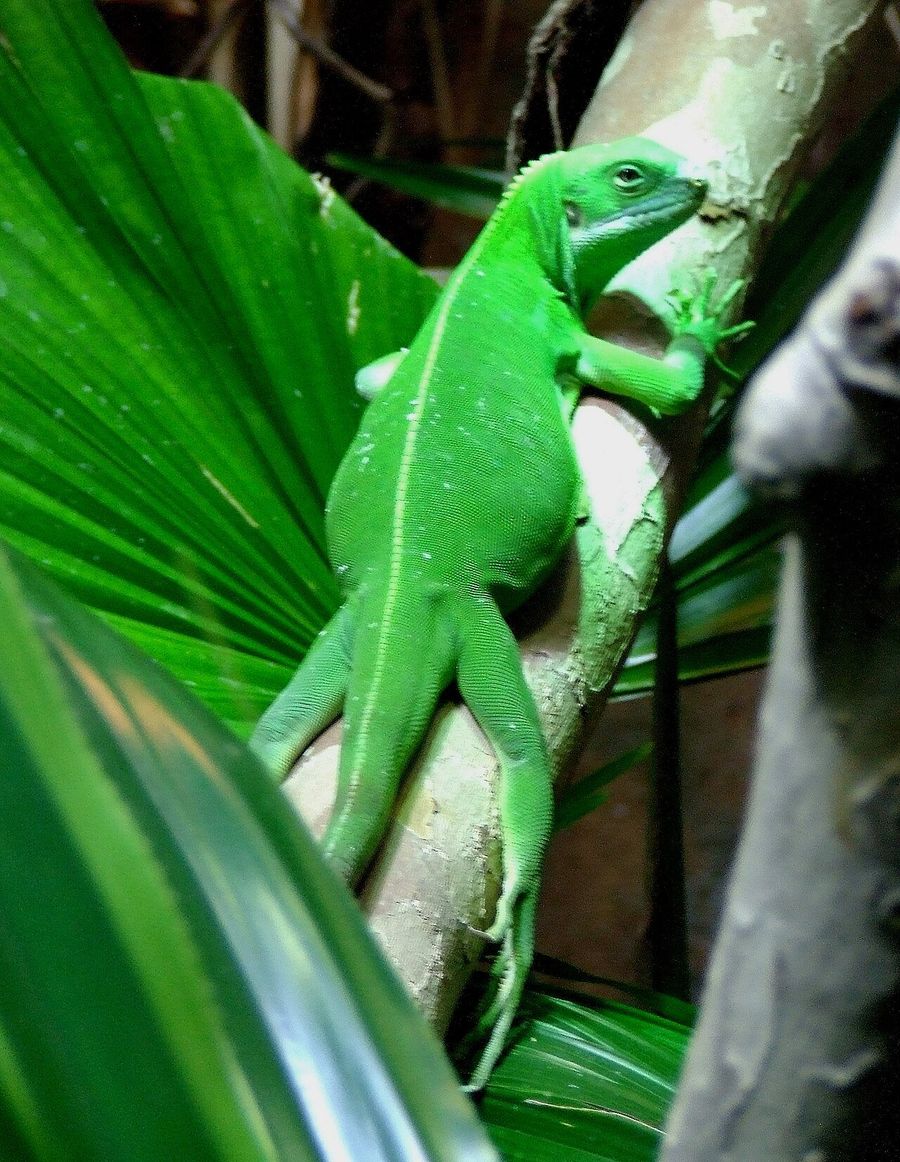
Males wear wide pale-blue or light-green bands on an emerald body. Females are usually plainer green, sometimes with a few pale spots. Like the rest of the genus they are canopy animals with a long tail for balance and a short dorsal crest of spines.

Central and northwestern Fiji. Some older records from other islands still need checking.
Moist to mesic forest, often a few hundred metres above sea level.
Leaves, fruit and flowers of native trees. They rarely come to the ground except to nest.
Forest clearing, fire, and introduced cats, rats and mongoose. Nesting females are especially vulnerable.
The International Iguana Foundation has estimated on the order of a few thousand animals scattered across islands, with no population considered secure. Zoo animals you see labelled “Fiji banded iguana” are often this species.